Congenital nasal anomalies: when should surgery be done?
The traditional view was to wait until adulthood; recent evidence supports limited early intervention, provided the growth centres are preserved. This article summarises the age milestones described in the literature.
For a child with a congenital nasal anomaly, the family's question is usually not “how to operate” but “when is it appropriate to operate”. The answer to this question has changed over the past few decades, and that change deserves a clear explanation.
The view has changed
A review of congenital nasal deformities describes how, in the past, correction was often postponed until adolescence because of concerns about effects on facial growth[1]. However, recent evidence supports earlier intervention, and this is leading to the traditional milestones being reconsidered[1].
The reconciling principle is stated clearly: early intervention is considered safe and effective when the growth centres are preserved[1]. In other words, the age milestone is not a fixed number but depends on whether the manoeuvre involves the growth centres.
Milestones described in the literature
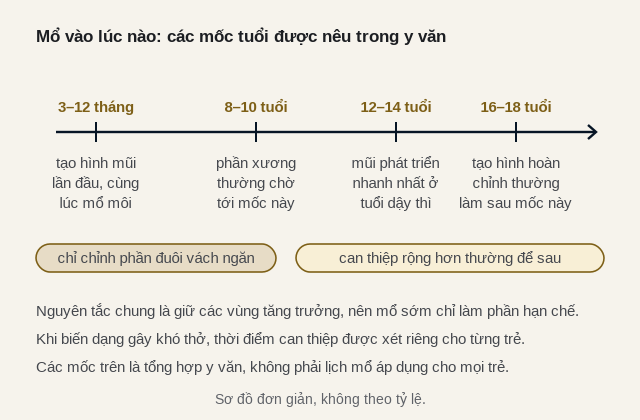
For the cleft lip nose, primary rhinoplasty is often performed together with the primary lip repair, at around 3 to 12 months of age[1]. At this early stage, septal correction is usually limited to the caudal septum and the anterior nasal spine; more extensive work on the bony septum or removal of large amounts of cartilage is usually left until later[1].
For facial clefts involving bone, the literature states that surgery is usually postponed until at least 8–10 years of age[1]. The nose grows most rapidly during puberty, around 12–14 years in girls[1]. For maxillonasal dysplasia, rhinoplasty in this group is usually performed at around 16–18 years of age[1].
There are situations that require intervention earlier than these milestones: when a severe nasal deformity causes airway problems, the timing of intervention is considered individually for each child[1]. The authors remain cautious: concerns about midface growth have not disappeared, and the evidence supporting early surgery for some types is based only on case reports and should be interpreted with caution[1].
Symmetry takes time
One point that worries many families is that the nose is still asymmetric after the first operation. A short review of nasolabial growth after primary lip repair in unilateral clefts compiles follow-up milestones from several different studies[2]. Among these: the nostrils remain asymmetric at 3 and 6 months after surgery, the nasal tip still deviates towards the non-cleft side at 9 months, and symmetry improves at around 12 months of age[2].
At later milestones, the alar width on the cleft side remains greater than in children without clefts at around 8–10 years, and columellar length is on average about 2 mm shorter in the group aged 7 to nearly 18 years[2]. However, three-dimensional imaging in adulthood in the group with isolated unilateral cleft lip showed no statistically significant nasal asymmetry[2].
This is a short review; all figures are compiled from other studies rather than original data[2]. Its value for families lies in the message: assessing the result too soon after surgery gives an inaccurate picture.
There is no universal surgical schedule
The age milestones above are reference points compiled from the literature, not a surgical schedule that applies to every child. A specific plan depends on the type of anomaly, its effect on breathing and feeding, other interventions in the treatment pathway, and the child's overall condition. Most interventions in this group require general anaesthesia and are carried out within a multidisciplinary pathway.
When should a child be seen early?
Bring your child for an early examination if they have difficulty breathing, noisy breathing, interrupted feeding or bluish discolouration around the lips during feeding; if they can only breathe through the mouth; or if there is an abnormal mass on the nasal bridge or nasal root, with a pit or sinus opening on the skin.
For older children, return for an examination if one-sided nasal obstruction gradually worsens, nosebleeds recur, or the shape of the nose changes noticeably within a short time.
Where procedures are performed
At the clinic, Dr. An examines and advises; procedures are performed only under local anaesthesia, according to the procedures approved by the Department of Health, which include cleft lip nasal deformities when rib cartilage harvest is not required. Cases requiring general anaesthesia, rib cartilage harvest or multidisciplinary care are performed at an appropriately licensed hospital. Dr. An will discuss the details at the consultation.
References
- Hullfish H, Williamson L, Close M, Kappauf C, Patel K. Congenital nasal deformities: advances in early surgical intervention. Plast Aesthet Res. 2025;12:36. doi:10.20517/2347-9264.2025.70
- Xu Y, Zeng N, Li J, Zheng Q, Shi B. Growth patterns of the nasolabial region following unilateral cleft lip primary repair. Front Pediatr. 2023;11:1136467. doi:10.3389/fped.2023.1136467
The references above are open-access publications by other groups of authors, listed for further reading. This article only summarises what the authors describe, along with the limitations of each study.
Learn more