
Brow ptosis: brow lift or upper eyelid skin excision?
These two procedures act in different places and do not replace each other. This article explains why upper eyelid skin excision can lower the brow, and the options available.
When the upper eyelid feels heavy and droops, many people immediately think of having some eyelid skin removed. But in some people, the excess eyelid skin is simply a consequence of the brow having descended. Distinguishing between these two situations is the decisive step, because the two approaches do not replace each other.
Upper eyelid skin excision can lower the brow further
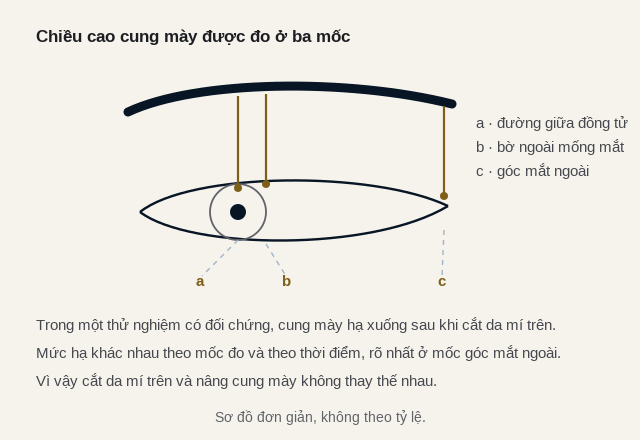
This is the point with the strongest evidence in this set of sources. A double-blind randomised controlled trial of 54 people undergoing upper eyelid skin excision measured brow height on standardised photographs at three landmarks: the mid-pupil, the lateral limbus and the lateral canthus[1]. Result: the brow descended after surgery in both technique groups, with the amount varying by landmark and by follow-up time point, and the two skin excision techniques did not differ in the amount of descent[1].
The mechanism was documented in this study by electromyography: in the skin-only excision group, electrical activity of the frontalis muscle decreased significantly after surgery[1]. In other words, when the excess skin is removed, the compensatory contraction of the frontalis decreases, and the brow returns to a lower position. The authors note the limitations: the study group had only mild headache symptoms before surgery, and the paper did not assess the levator muscle[1].
This does not mean upper eyelid skin excision is wrong. It means that if the brow is already ptotic, skin excision alone may not solve the problem, and the possibility of further brow descent should be discussed beforehand.
Lifting the brow first reduces the eyelid skin that needs to be removed
A retrospective clinical audit of 179 people who had a brow lift through the upper eyelid incision itself found that this manoeuvre reduced the amount of skin to be excised in the lateral third by about 2 to 4 mm, depending on the planned elevation[2]. This is direct evidence for the argument that the two are related.
The same case series recorded about 2.79% temporary pain in the dissected temple area, resolving after two to three months; no seromas, haematomas or infections were reported[2]. This paper has no limitations section, contains a few self-contradictory figures, and did not measure postoperative brow elevation in millimetres.
Brow lift methods and their trade-offs
A direct brow lift, with an incision right along the upper edge of the brow, is described in one literature review as providing the strongest lift[3]. The trade-off is an incision in a visible area. That review pooled data on about 900 people and noted that the scar was described as inconspicuous in most cases, but the authors themselves note the limitation that outcome reporting was very heterogeneous across studies and many scar characteristics were recorded only sporadically[3].
A larger case series, 697 people undergoing a forehead lift through a hairline incision with subcutaneous dissection, gives specific complication figures: 91.4% had no complications; hypertrophic scarring 4.6%; prolonged numbness 2.6%, usually recovering within about two to three months; haematoma 0.8%; infection 0.3%[4]. The authors themselves state that excluding cases followed for less than 6 months may have underestimated the rate of late complications[4]. Note that this paper assessed results using wrinkle scores, not brow position, so it cannot be used to say how many millimetres of lift were achieved.
For the endoscopic approach, one review notes that releasing the periosteum at the supraorbital rim can achieve an elevation of about 4–10 mm, and emphasises the danger zone to avoid the sensory nerve branches[5]. But the same review states that there is no fixed distance landmark that applies to everyone, current evidence is insufficient to confirm that any one dissection plane is superior, and the paper gives no complication rates[5].
When should a child be seen early?
Seek medical attention if brow ptosis appears rapidly on one side, together with weakness of one side of the face, a drooping mouth or difficulty closing the eye — this is a different condition and needs early examination.
After surgery, contact your doctor if the incision becomes increasingly swollen and painful, redness spreads or it discharges cloudy fluid; if incomplete eye closure, grittiness or light sensitivity persists; if forehead numbness does not improve after a few months; or if the two brows are clearly uneven.
Where procedures are performed
At the clinic, procedures are performed only under local anaesthesia, within the procedures approved by the Department of Health; other operations and cases requiring general anaesthesia are performed at an appropriately licensed hospital. Dr. An will discuss the details with you at your consultation. Forehead lift and temporal lift are performed at the clinic; endoscopic temporal – midface lift is performed at an appropriately licensed hospital.
References
- Hollander MHJ, van der Hoeven JH, Verdonschot KHM, Delli K, Vissink A, Jansma J, et al. Effects of upper blepharoplasty techniques on headaches, eyebrow position, and electromyographic outcomes: a randomized controlled trial. Int J Environ Res Public Health. 2023;20(2):1559. doi:10.3390/ijerph20021559
- Sforza M, Zaccheddu R, Sforza D. Transpalpebral eyebrow lift: the mini eyebrow lift. Plast Aesthet Res. 2018;5:2. doi:10.20517/2347-9264.2017.35
- Khan AZ, Boberg-Ans LC, Fineide FA, Allen RC, Bohman E, Tønseth KA, et al. Contemporary concepts and techniques for scar minimization in direct brow lift: a literature review. J Clin Med. 2026;15(12):4445. doi:10.3390/jcm15124445
- Lim SB, Jung ES, Jung M, Koh IC, Lim SY, Ryu WC. Wrinkle reduction in forehead and glabella regions after subcutaneous forehead lift: a retrospective analysis using the wrinkle assessment scale. Front Surg. 2026;13:1776372. doi:10.3389/fsurg.2026.1776372
- Zhou B, Liu B, Lan T. Anatomy-guided dissection plane selection in endoscopic brow lift: a narrative review of supraperiosteal, subperiosteal, and multiplane approaches. Front Surg. 2026;13:1856741. doi:10.3389/fsurg.2026.1856741
The references above are open-access publications by other groups of authors, listed for further reading. This article only summarises what the authors describe, along with the limitations of each study.
Learn more