
Revision after aesthetic surgery: why is waiting usually necessary?
Tissue needs time for swelling to settle and to stabilise, and a revision operation is harder than the first because of scar tissue, blood supply and available tissue. This article explains how the doctor decides whether to wait or to intervene.
When a result is not as hoped, the natural reaction is to want to fix it right away. But in most cases the doctor's first answer is to wait, and this is not a delay for its own sake. This article explains why timing matters so much.
The tissue is still changing
Swelling and oedema after surgery subside gradually rather than disappearing all at once. A retrospective study of 1,047 people who underwent lower eyelid surgery showed that prolonged chemosis can last from three weeks to six months, depending on the technique[2]. For the nose, the authors describe that the course of a contracted nose after surgery also needs to be followed at several time points during the first year[3]. Judging a result while the tissue is still changing can easily lead to the wrong decision.
For nasal revisions, one review recommends waiting a full year after the first operation before reoperating, while noting that there are significant exceptions[1]. In breast reconstruction after radiotherapy, the authors usually wait 6–12 months after radiation ends, and state clearly that no standard interval applies universally[4]. In other words, the specific figure varies by region and situation; the general principle is that the tissue must be stable first.
Why a revision is harder
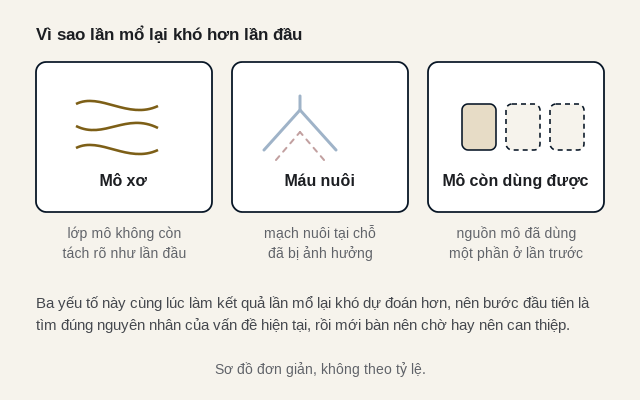
The review mentioned above lists factors that limit the outcome of revision surgery: scar tissue, local blood supply, the complexity of the deformity and other technical factors[1]. In reconstruction after radiotherapy, the authors describe the same three groups of difficulties: a surgical pocket and skin that have become fibrotic after the previous intervention, compromised recipient vessels, and donor tissue that has already been used or is insufficient[4].
In a nose that has had multiple operations, this is very concrete: a contracted skin–soft tissue envelope limits redraping, and septal and conchal cartilage have often been harvested previously, leaving little tissue[3]. For the same reason, the change achieved is often more modest than patients imagine: for a contracted nose, the authors note that nasal length usually increases by only about 3–4 mm despite extensive reconstruction[3].
“Waiting” does not mean doing nothing
During the waiting period, the task is to identify the right cause: the technique used previously, the healing process, scar tissue, or a gap between expectations and reality. Some minor concerns can be managed with non-surgical measures before surgery is considered[1].
It is also important to know that the doctor may advise against revision. In one cited study, surgeons declined to reoperate for various reasons in 76% of the patients seen; some were scheduled for further follow-up and some were referred for a second opinion[1]. Revision rates after rhinoplasty are reported at around 5–15%[1]. These figures come from specific patient groups and are not rates that apply everywhere.
Cases that should not wait
The waiting principle does not apply to complications. Infection, implants at risk of extrusion, bleeding, wound dehiscence or signs of compromised tissue perfusion need early management. In addition, a new or persistent wound in a previously irradiated area should be biopsied to rule out recurrent malignancy[4]: this is a safety issue, not an aesthetic one.
When should a child be seen early?
See a doctor immediately if the surgical area becomes increasingly swollen and painful, redness spreads, there is cloudy or foul-smelling discharge, the wound opens, implant material becomes visible, or you develop a fever. If you have bleeding that will not stop, difficulty breathing or chest pain, call 115 or go to the emergency department.
See a doctor promptly, without waiting for the scheduled time point, if an area of skin changes colour abnormally, if pain increases instead of decreasing, or if a new ulcer appears in a previously operated or irradiated area.
Where procedures are performed
At the clinic, procedures are performed only under local anaesthesia, within the list of procedures approved by the Department of Health; revision after eyelid surgery, revision after facelift, scar revision of the face and neck, nasal revision not requiring rib cartilage harvest, and removal of facial filler materials are performed at the clinic. Cases requiring rib cartilage harvest and revision after breast surgery, abdominoplasty or body liposuction are performed at an appropriately licensed hospital. Dr. An will discuss the details during your consultation.
References
- Zhang K, Deane EC, Becker DG. Persistent cosmetic dissatisfaction in rhinoplasty and management of the difficult patient. Plast Aesthet Res. 2024;11:23. doi:10.20517/2347-9264.2023.111
- Di Maria A, Barone G, Gaeta A, Confalonieri F, Vinciguerra P, Vinci V, et al. Persistent conjunctival chemosis after lower lid blepharoplasty: a comparison of different surgical techniques. J Clin Med. 2024;13(7):2093. doi:10.3390/jcm13072093
- Jin S, Jin HR, Won TB. Reconstructive rhinoplasty for the contracted Asian nose. Plast Aesthet Res. 2025;12:33. doi:10.20517/2347-9264.2025.69
- Sorenson TJ, Boyd CJ, Cohen O, Choi M, Karp N. Microsurgical strategies in post-radiation and revision breast reconstruction: optimizing outcomes in high-risk patients. Cancers (Basel). 2025;17(23):3831. doi:10.3390/cancers17233831
The references above are open-access publications by other groups of authors, listed for further reading. This article only summarises what the authors describe, along with the limitations of each study.
Learn more