
Contracted nose and short nose: why is this the most difficult group?
The cartilage framework can be rebuilt, but the skin and inner lining cannot stretch indefinitely. This article explains the real limits of lengthening a contracted nose.
A contracted nose is a condition in which the nose has been pulled shorter, the tip turned up and the nostrils more visible, usually after one or more previous operations. This is the group in which the gap between expectations and results can be largest, and the reason lies where many people do not expect.
The cause is not only cartilage
A review of the overly short nose describes that this condition can result from trauma, infection, inflammatory disease, or a previous operation that damaged the soft tissue and cartilage framework of the nose[1]. Postoperative contracture can rotate the tip upward and cause the nose to lose length[1].
In the group with multiple previous operations, the authors describe two overlapping problems: a contracted skin and soft tissue envelope that limits redraping, and septal and conchal cartilage that have often been harvested previously, leaving little tissue[2].
The limit lies in the soft layers
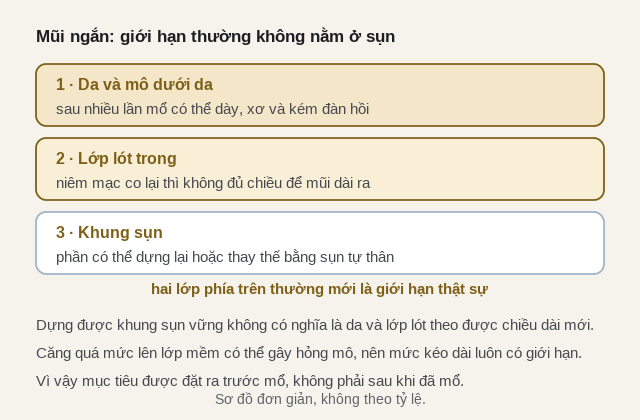
This is the central point. The review states that it is the insufficient pliability of the soft tissue and the inner mucosal lining, not the cartilage, that usually limits nasal lengthening[1]. The authors warn that forcing the soft tissue over a newly lengthened cartilage framework can create excessive tension on the skin, and if the mucosa is overstretched the tissue may fail[1].
The practical consequence: the change achieved is often more modest than patients imagine. For a contracted nose, some sources note that nasal length usually increases by only about 3–4 mm despite extensive reconstruction[2].
The review also states plainly that even when the necessary manoeuvres are performed, the desired length may not be achieved, and patients need a thorough discussion of the soft tissue-related limits before surgery[1]. The authors themselves acknowledge that very few studies evaluate outcomes in this patient group, so most of the content reflects practical experience rather than data[1].
A different cartilage source and a different plan are needed
Because a contracted nose needs its length rebuilt rather than simply raised, the framework must withstand the counter-pull of the contracted tissue. In a table summarising the causes leading Asian patients to undergo revision rhinoplasty, contracture causing a short nose is listed among the problems related to implants placed in a previous operation[3]. Note that the figures in that table are the reasons patients sought revision, not outcomes after revision.
When septal cartilage has been harvested previously, rib cartilage is usually the remaining source. A technical article for Asian patients noted that the rib cartilage segments harvested were longer in revision cases than in primary cases[4]. The article also notes that rib cartilage harvest carries a risk of pneumothorax, and describes an intraoperative check by filling the donor site with saline and watching for air bubbles during positive-pressure ventilation[4].
The authors of the review advise against using tip grafts alone as a way of lengthening the nose, and state that relying on such methods without an adequate supporting foundation leads to results that are not durable in the long term[1].
Why waiting is necessary
Contracted tissue needs time to stabilise before it is reassessed. This is covered separately in the article on the timing of revision surgery. Here, only one point needs to be remembered: the goal of the next operation should be set and agreed before surgery, based on the current state of the skin and lining, not on the image of the nose before the first operation.
When should a child be seen early?
Contact your doctor if the skin over the nasal tip or dorsum becomes red, shiny and tight, increasingly painful or discoloured, if cloudy discharge appears, or if you feel an unusually soft spot — these may be signs of infection or implant exposure.
If the nose is gradually getting shorter, the nostrils are becoming more visible month by month, or nasal obstruction is increasing, return for an examination rather than waiting for your scheduled appointment.
Where procedures are performed
At the clinic, procedures are performed only under local anaesthesia, within the list of procedures approved by the Department of Health; nasal revision not requiring rib cartilage harvest is performed at the clinic. Cases requiring rib cartilage harvest or general anaesthesia are performed at an appropriately licensed hospital. Dr. An will discuss the details during your consultation.
References
- Patel PN, Longino E, Most SP. The excessively short nose: our systematic approach. Plast Aesthet Res. 2024;11:20. doi:10.20517/2347-9264.2024.17
- Jin S, Jin HR, Won TB. Reconstructive rhinoplasty for the contracted Asian nose. Plast Aesthet Res. 2025;12:33. doi:10.20517/2347-9264.2025.69
- Won TB, Jin HR. Revision rhinoplasty using autologous rib cartilage in Asians. Plast Aesthet Res. 2019;6:6. doi:10.20517/2347-9264.2018.82
- Rajbhandari S, Kao CH. Costal cartilage graft in Asian rhinoplasty: surgical techniques. Plast Aesthet Res. 2019;6:8. doi:10.20517/2347-9264.2018.86
The references above are open-access publications by other groups of authors, listed for further reading. This article only summarises what the authors describe, along with the limitations of each study.
Learn more