
Thread lifting: what it can do, and what the literature does not yet know
Thread lifting is a procedure under local anaesthesia with a short recovery, but the evidence on how long results last is very thin. This article summarises a meta-analysis of complications and the gaps that anyone considering it should know about.
Thread lifting involves passing barbed or otherwise tissue-anchoring threads into the subcutaneous layer to pull and support the soft tissues of the face. It is usually performed under local anaesthesia, without long incisions, and recovery is faster than with surgery. These advantages are real. What is less often said is that the literature knows a fair amount about complications, but very little about how long the results last.
What a meta-analysis shows
A systematic review with meta-analysis pooled 26 studies with 2,827 people, published from 2002 to 2021, with follow-up from 4 weeks to 30 months[1]. Of the 26 studies, the authors rated 9 as high quality, 15 as moderate and 2 as low[1].
Pooled rates of some complications in the results section were: visible or palpable threads about 10%, skin dimpling about 7%, bruising about 26%, pain about 11%, thread extrusion about 5%, and infection about 2%[1]. Heterogeneity between studies was very high, and for some complications the figure in the abstract differs from the figure in the paper’s own forest plot — swelling, for example — so no figure is given here for that complication.
The authors note that facial nerve branch injury, parotid duct injury and granulomatous reactions were reported only in isolated case reports, not in the pooled studies[1]. There are therefore no reliable rates for these complications — which does not mean they do not occur.
Early and late complications
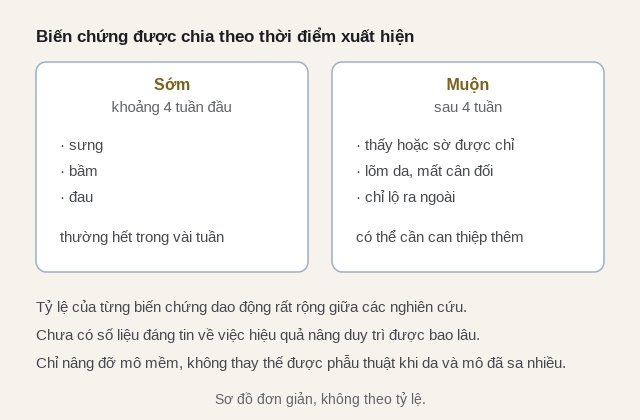
The meta-analysis grouped complications by timing: within roughly the first four weeks, swelling, bruising and pain; after four weeks, visible threads, dimpling and thread migration[1]. According to the pooled studies, swelling usually resolved within 2–4 weeks, bruising within 1–3 weeks, and in a few studies, dimpling resolved within 3–6 months[1].
This distinction is useful in practice. Early problems usually settle on their own and only need monitoring. Late problems — a thread end protruding under the skin, a dimple that does not go away, a segment of thread showing through — are a reason to come back for review, as adjustment or thread removal may be needed.
What the literature cannot yet answer
This is the most important part of the article. This meta-analysis addresses complications only; it contains no data on how long the lifting effect lasts[1]. Among the open-access sources we reviewed, none measured the durability of results with an objective method. The durations patients often hear — in months or years — we have not found supported by a verifiable study.
The meta-analysis authors also acknowledge limitations: the studies varied widely in technique and patient characteristics, only English-language papers were included, there was no separate analysis by thread type or design, and many studies were retrospective and thus subject to recall bias[1].
What threads can and cannot do
Threads act only on superficial soft tissue. When the skin is already very thin and lax, fat has clearly descended, or the jawline and neck have sagged considerably, pulling with threads cannot replace what surgery does at deeper layers. So the question before choosing threads is not “which type of thread” but “is the current state of the tissues within the range that threads can address”.
Suitable candidates are usually people with mild laxity who accept that the effect is limited and may need to be repeated, and who clearly understand the possible late complications.
When should a child be seen early?
Contact your doctor if the treated area becomes red, warm, swollen and increasingly painful after the first few days, if cloudy fluid drains from a thread entry point, or if you develop a fever — these may be signs of infection.
Come back for review if you can feel a thread end protruding under the skin, a segment of thread is exposed, a dimple has not improved after a few weeks, or facial movement is restricted or asymmetric.
Where procedures are performed
At the clinic, procedures are performed only under local anaesthesia, within the procedures approved by the Department of Health; thread lifting is a procedure under local anaesthesia and is performed at the clinic. Other surgeries and cases requiring general anaesthesia are performed at an appropriately licensed hospital. Dr. An will discuss the specifics at your consultation.
References
- Zhou X, Zhuang S. A meta-analysis of complications of thread lifting. Front Surg. 2026;13:1769458. doi:10.3389/fsurg.2026.1769458
The references above are open-access publications by other groups of authors, listed for further reading. This article only summarises what the authors describe, along with the limitations of each study.
Learn more