
Uneven double eyelids after surgery: how are they managed?
Not every result you are unhappy with needs another operation, and not every eyelid crease that looks uneven is a technical error. This article explains the common causes, how long to wait, and what can be done without surgery.
After eyelid surgery, what worries people most is usually not pain but the feeling that the two sides do not match. Most of these concerns arise in the first few weeks, exactly the period when no conclusion can yet be drawn. This article summarises how the literature describes this problem.
Normal eyes are never perfectly symmetrical
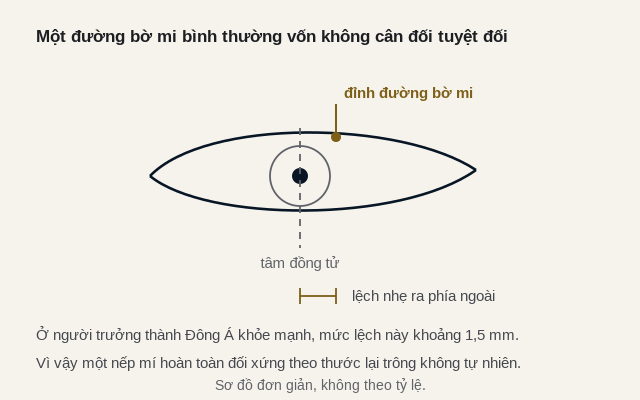
This is worth knowing before comparing the two sides with a ruler. A study measuring the upper lid margin in 80 healthy Korean adults found that its highest point did not lie exactly over the centre of the pupil but slightly to the outer side, by about 1.67 mm in women and 1.49 mm in men, and the difference between the sexes was not statistically significant[1].
The authors note its limitations: only Korean subjects were studied, the method requires digital image processing and is therefore hard to use routinely, and ratios are more meaningful than absolute lengths[1]. The study also did not measure the eyelid crease.
The early phase: most cases do not yet need surgery
An observational study of 30 women with unsatisfactory early double-eyelid results — including multiple creases, sunken lids and prolonged postoperative swelling — treated them with local anti-inflammatory injections starting from the third week after surgery[2]. Results: 17 women (56.67%) improved clearly after one injection; 8 improved after a second injection one month later; 5 (16.67%) were still not satisfied and might need revision surgery[2].
These figures need to be read in context. The study team had already excluded difficult cases — loss of the crease, weak upper lid, tarsal deformity after infection, and people with multiple previous eyelid surgeries — so the rate above does not apply to every unsatisfactory result[2]. The study also had no control group, so it cannot rule out that early swelling and multiple creases would have resolved on their own over time[2].
The same article states a minimum wait of three months after the first operation before considering revision, and notes that a second operation may worsen scarring and prolong recovery[2].
If revision surgery is needed
A retrospective case series of 102 patients (137 eyes) with unsatisfactory results after double-eyelid surgery shows the range of causes: iatrogenic ptosis in 37 eyes, upper lid retraction in 11 eyes, and other deformities such as multiple creases, skin deficiency and asymmetry[3]. The authors attribute most of the difficult cases to excessive removal of skin, orbicularis oculi muscle and orbital fat at the previous operation[3].
On timing, the study's inclusion criteria required at least 6 months since the most recent operation, and in the discussion the authors recommend waiting 3–6 months before correcting iatrogenic ptosis, to let swelling settle and allow some of the ptosis to recover on its own[3].
Results of that same series: on surgeon-rated grading, 79.4% were excellent and 8.8% good, but about one in nine remained fair or poor[3]. This is surgeon-rated grading, not a patient satisfaction score, and the authors note that the small subgroups may have led to an underestimate of the recurrence rate in severe cases[3].
The longer-term course
A retrospective study of 333 double-eyelid patients followed for up to 5 years found that satisfaction declined gradually over time in both technique groups, and fading of the crease was the most common change in the small-incision group[4]. This study did not define “recurrence” and did not report a reoperation rate, so its figures should be interpreted with caution[4].
Regarding scars, a review of scar reduction after upper blepharoplasty reports hypertrophic scarring in about 1% of eyelid procedures in general, and wound dehiscence in 1–2%, on average on day nine[5]. The same review makes a practical point: the topical agents studied may improve redness and hyperpigmentation in the early phase but do not change the final scar, and most studies followed patients for only 2–6 months, which is too short to assess the final scar[5].
When should a child be seen early?
Contact your doctor immediately if you have severe eye pain, blurred vision, rapidly increasing swelling on one side, a tense purple eyelid, or cloudy discharge with fever.
See your doctor again if the eye cannot close fully for a prolonged period, if redness, grittiness and light sensitivity do not improve, if one eyelid droops, or if the incision scar becomes thick and red after 6–8 weeks.
Where procedures are performed
At the clinic, procedures are performed only under local anaesthesia, within the procedures approved by the Department of Health; revision eyelid surgery is performed at the clinic. Cases requiring general anaesthesia are performed at an appropriately licensed hospital. Dr. An will discuss the details with you during your consultation.
References
- Shin DY, Cho WK, Paik JS, Yang SW. Upper eyelid contour measurement in an Asian population using Bézier curve analysis. PLoS ONE. 2025;20(6):e0316714. doi:10.1371/journal.pone.0316714
- Zhang S, Zhou Y, Yu F, Yan D, Yan Y, Zhou M, et al. Management of unsatisfactory postoperative double eyelid with intralesional corticosteroid injection. Front Med. 2021;8:619547. doi:10.3389/fmed.2021.619547
- Shen Y, Yu S, Jin R, Lu L, Yang J, Yu W. Application of the bridge technique in revisional blepharoplasty in Asian patients. Plast Aesthet Res. 2026;13:22. doi:10.20517/2347-9264.2026.18
- Cao J, Yan L. The small incisions combined with interrupted buried suture blepharoplasty: flexible-rigid fixation. Front Med. 2024;11:1383937. doi:10.3389/fmed.2024.1383937
- Fineide FA, Khan AZ, Boberg-Ans LC, Allen RC, Bohman E, Tønseth KA, et al. Minimizing postoperative scars in upper eyelid blepharoplasty: a concise review. Surgeries. 2025;6(4):93. doi:10.3390/surgeries6040093
The references above are open-access publications by other groups of authors, listed for further reading. This article only summarises what the authors describe, along with the limitations of each study.
Learn more