
Liposuction: how much can be removed, and where are the limits?
The volume that can be removed is calculated by body weight, not in litres, and not every area can be treated with liposuction. This article explains the published limits, complication rates and what this technique cannot do.
“How many kilos can be removed?” is the most common question about liposuction. But the volume removed is not the goal, nor is it an open-ended number. This article explains the limits described in the literature and why surgeons stop at a certain point.
Which fat can this technique reach?
Subcutaneous fat is divided into a superficial and a deep layer, separated by a thin fascial membrane; the fat removed comes mainly from the deep layer, while most of the superficial layer is preserved to keep the skin surface smooth.
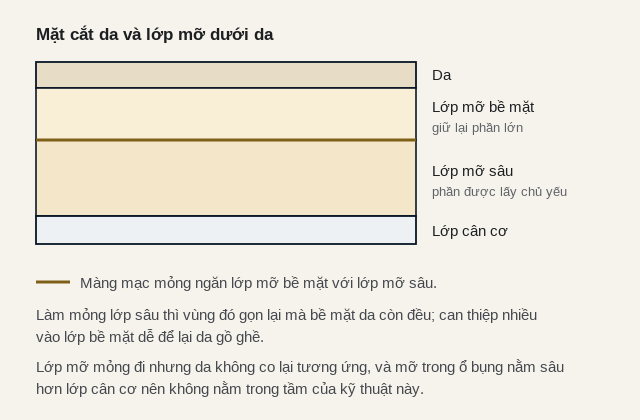
Fat inside the abdominal cavity, beneath the muscle fascia, is outside the reach of this technique. So a large abdomen caused by visceral fat will not change much after liposuction, however much is removed.
Volume is calculated by body weight, not in litres
A multidisciplinary consensus paper recommends limiting the volume removed to about 5–7% of body weight, counting everything in the collection canister rather than just the supernatant fat; in Brazil, medical council regulations set the limit at 7% of body weight with infiltration and 5% without, together with a limit of 40% of body surface area[1]. The authors themselves state clearly that the 7% figure is based on experience rather than evidence[1].
Studies also do not define “large volume” in the same way: some count the fat removed, others include the infiltrated fluid, so the figures cannot be compared directly[4]. A retrospective study of 121 lower-limb liposuction procedures in patients with lipoedema used more than 5 litres as the large-volume threshold, with a mean volume of 8.2 litres; notably, the complication rate there did not correlate with the volume aspirated but with preoperative anaemia, whereas the volume aspirated correlated with the drop in haemoglobin (a mean decrease of about 3 g/dL) and with length of hospital stay[3]. That was a specific patient group, at a single centre, studied retrospectively, so it cannot be generalised to every case; but it shows why preoperative blood tests matter as much as the volume figure.
Other limits: number of areas, operating time, health
The consensus paper above recommends limiting combined aesthetic procedures to one session and to about three hours, stopping smoking 6–8 weeks before surgery, and checking haemoglobin before surgery[1]. In a series of 60 large-volume liposuction cases, most patients had two areas treated in one operation, and at most three areas[4].
The number of areas and combining other procedures are not minor matters. A systematic review reports a thromboembolism rate of 0.06% with liposuction alone (in 31,010 patients) versus 0.56% when combined with other procedures; surgical site infection 0.1% versus 0.7%; and seroma 2.16% with drains versus 9.17% without[2]. The same review notes that contour irregularities were reported in up to about 9% in one study, and lists thromboembolism as one of the most common causes of death after liposuction[2]. These figures are pooled from many different studies with different sample sizes and follow-up methods.
What liposuction cannot do
Liposuction is not a weight-loss method and does not replace keeping your weight stable. The fat layer becomes thinner but the skin does not shrink correspondingly, so loose skin remains loose. The surface may become uneven, especially when the superficial fat layer is treated extensively; in the 60-case series above, skin irregularities were reported in 20% and seroma in 15%[4]. Some cases need revision later on.
When should a child be seen early?
Call 115 or go to the emergency department immediately if after surgery you have shortness of breath, chest pain, cough up blood, or have one calf that is swollen, painful, warm and red: these may be signs of thrombosis and pulmonary embolism. Also go immediately if you feel dizzy, faint, have a racing heart or pale skin.
Tell your surgeon right away if swelling and pain in the operated area keep increasing, if there is cloudy or foul-smelling discharge, fever, or if an area of skin changes colour abnormally.
Where procedures are performed
At the clinic, Dr. An provides examination and consultation. Body liposuction procedures are performed at an appropriately licensed hospital. Dr. An will discuss the details with you during your consultation.
References
- Fernandes JW, Miró A, Rocha AAS, Mendonça CT, Franck CL, Itikawa WM. Practical criteria for a safer liposuction: a multidisciplinary approach. Rev Bras Cir Plást. 2017;32(3):454-466. doi:10.5935/2177-1235.2017RBCP0075
- Barros LFL, Teixeira VF, Reis Júnior JAP, Ferraz RA, Araújo DC, Vendramin FS. Complications in liposuction: systematic review. Rev Bras Cir Plást. 2023;38(1):e0641. doi:10.5935/2177-1235.2023RBCP0641-EN
- Flores T, Kremsner B, Schön J, Riedl J, Sabitzer H, Glisic C, et al. Lipedema: complications in high-volume liposuction are linked to preoperative anemia. J Clin Med. 2024;13(24):7779. doi:10.3390/jcm13247779
- Saleh Y, El-Oteify M, Abd-El-Salam AR, Tohamy A, Abd-Elsayed AA. Safety and benefits of large-volume liposuction: a single center experience. Int Arch Med. 2009;2:4. doi:10.1186/1755-7682-2-4
The references above are open-access publications by other groups of authors, listed for further reading. This article only summarises what the authors describe, along with the limitations of each study.