
Chin implants: what does the surgeon assess before placement?
Chin position, dental occlusion, soft-tissue thickness and the course of the nerve determine whether an implant is appropriate. This article explains the reference landmarks and the risks to know in advance.
“A receding chin needs a chin implant” sounds like simple arithmetic. But before discussing implant size, the consultation has to answer another question: where is the deficiency, and is it really in the chin? This article explains what the surgeon looks at.
The chin is assessed within the face as a whole
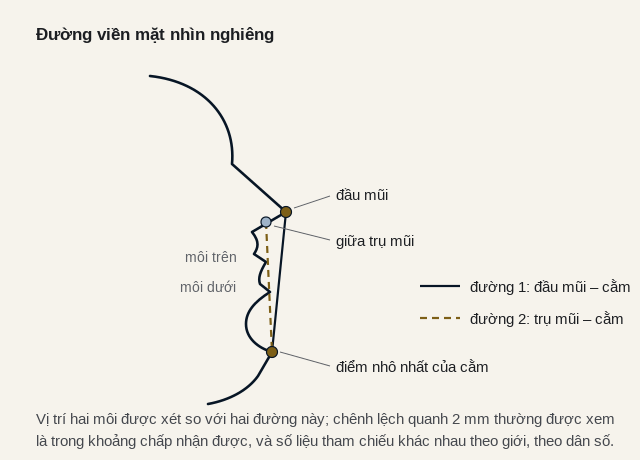
In profile, the chin is assessed in relation to the nose and lips rather than on its own. Two classic reference lines are used: one joining the nasal tip to the most prominent point of the chin, and one joining the mid-columella to that point[1]. The position of the lips relative to these lines is recorded, with a deviation of about 2 mm usually considered within the acceptable range[1].
A study of 68 patients undergoing orthognathic surgery recorded that before surgery the chin point lay about 8 mm from the median reference position in the anteroposterior direction[1]. That was a group with marked jaw discrepancies, in a specific population, so this figure is a reference point, not a target to be reached.
Dental occlusion: when an implant is not the answer
This point is easily overlooked. If the chin is retruded because of the relationship between the jaws, placing an implant in front only masks the outward appearance. In a series of revision operations for complications of silicone chin implants, the author noted that a considerable proportion of the original indications were to use an implant to compensate for a Class II jaw relationship, and concluded that implants should not be used routinely for this purpose[4]. For this reason, your occlusion is examined; if there is any doubt, you will be referred to an oral and maxillofacial specialist before going further.
Bone base, soft tissue and the course of the nerve
The chin region has a small opening on the outer surface of the lower jaw, where a sensory nerve branch emerges to supply the lower lip and chin. A CT study of 344 people (688 foramina) found that this opening lies on average 13.55 mm from the lower border of the jaw, most often below the second premolar (57.9%), and that the two sides are not entirely identical[2]. This is why the implant pocket is created in an appropriate position and dissection is kept low: injury to this nerve branch causes numbness of the lip and chin.
The thickness of the overlying soft tissue is also assessed, because the thinner the tissue, the more easily the edges of the implant can be felt or become exposed.
Bone resorption under the implant, displacement and late infection
The bone beneath an implant may gradually become depressed over time. A systematic review of 28 studies found that the reported rates vary very widely, from 0% to almost all patients depending on the study; in studies with less than 5 years of follow-up, the mean depression was under 2 mm, and only 4 studies had a mean follow-up of more than 10 years[3]. In other words, the true prevalence is still unclear, but the phenomenon is real and increases with length of follow-up.
The revision series above shows that reasons for reoperation included bone resorption, implant displacement, or both, in addition to dissatisfaction with the shape; the author emphasises placing the implant directly on the bone and fixing it securely[4]. That was a group of people who came in because they already had complications, most of whom had been operated on elsewhere, so it does not represent the overall rate for the technique.
One practical point worth remembering: in that series, the reported case of infection occurred after a filler injection elsewhere, two years after the implant had healed[4]. An artificial material in the body needs to be taken into account whenever you have another procedure in the surrounding area.
When should a child be seen early?
See a doctor right away if the chin area becomes increasingly swollen and painful, red, warm, or draining, or if material becomes visible through the skin or the lining of the mouth; infection related to an implanted material needs early treatment and sometimes removal of the implant.
Tell your doctor if numbness of the lower lip or chin persists, if the implant feels clearly displaced, or if you are planning filler injections or dental treatment in the area around the implant.
Where procedures are performed
At the clinic, procedures are performed only under local anaesthesia, within the procedures approved by the Department of Health; chin and cheekbone implants (primary placement, replacement, revision) and removal of facial implants are performed at the clinic. Mandibular angle, mandibular border and temporal implants, and cases combining implants with fat grafting, are performed at an appropriately licensed hospital. Dr. An will discuss the details with you during your consultation.
References
- Singh P, Han H, Zhang H, Hsung RTC, Lin Y, Ajmera DH, et al. Determining post-orthognathic surgery profile: a validation study on the potential of modified chin point as a reliable predictor. PLoS One. 2025;20(8):e0329535. doi:10.1371/journal.pone.0329535
- Muinelo-Lorenzo J, Fernández-Alonso A, Smyth-Chamosa E, Suárez-Quintanilla JA, Varela-Mallou J, Suárez-Cunqueiro MM. Predictive factors of the dimensions and location of mental foramen using cone beam computed tomography. PLoS One. 2017;12(8):e0179704. doi:10.1371/journal.pone.0179704
- Yeung AWK, Wong NSM. Mandibular bone resorption following chin augmentation: a systematic review. Front Surg. 2022;9:815106. doi:10.3389/fsurg.2022.815106
- Pokrowiecki R. Revision surgery after complications of silicone chin implants. J Clin Med. 2026;15(4):1326. doi:10.3390/jcm15041326
The references above are open-access publications by other groups of authors, listed for further reading. This article only summarises what the authors describe, along with the limitations of each study.
Learn more