
Implants or fat grafting for the face: how to choose?
Implants supplement the bone base; fat grafting supplements the soft-tissue layer. This article compares the two approaches by tissue layer, fat retention rates in the literature and the specific risks of each.
When an area of the face looks hollow or lacks fullness, two augmentation approaches are commonly mentioned: placing an implant or grafting autologous fat. They are not two versions of the same thing. This article explains the differences and how to weigh them.
Two ways of adding volume, at two different layers
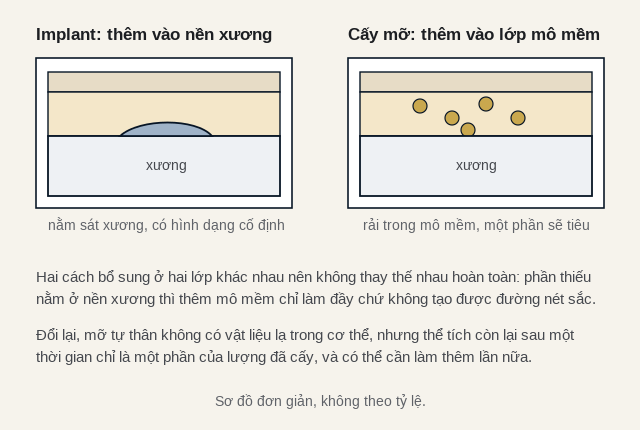
An implant lies directly on the bone and supplements the bone base; autologous fat is distributed within the soft-tissue layer above. A review of facial implant materials states plainly that fat grafting cannot replace augmentation of the bone base, and that when the deficiency lies in the bone, adding only soft tissue tends to give less defined contours[2]. Conversely, when the problem is facial fat thinning with age, a rigid block of material on the bone does not solve it.
How much grafted fat remains?
This is a figure to know before deciding. A review of complications of facial fat grafting cites a meta-analysis of 12 studies: about 50–60% of the grafted volume remained at one year, with a range between studies of 20% to 80%[1]. This wide range reflects differences in fat processing technique, recipient site and measurement methods between studies.
So the possibility of a further session should be considered in advance. In a retrospective study of 105 patients who had facial fat grafting, 16 (about 15%) had one additional touch-up session at the three-month follow-up[3]. This study did not measure volume with imaging and had no control group, so the figure only describes the experience of one centre.
Each approach carries different risks
For fat grafting, the review above reports an overall complication rate of about 2.27% in a meta-analysis of 4,577 patients, while another systematic review gives a figure of 7.7%; common complications are prolonged swelling, contour irregularities and fat necrosis, while infection ranges from about 0.10–0.54%[1]. Fat grafting also carries a group of risks that implants do not: the donor site, with a complication rate of 5.5% in a series of 416 cases[1].
The rarest but most serious risk of fat grafting is fat entering a blood vessel. The review notes that the frequency differs clearly by injection site, being higher in the glabella and forehead and lowest in the cheeks; the reported cases of ocular vascular injury all resulted in severe visual consequences[1]. This is why the injection site and depth are considered carefully.
With implants, the risk profile is quite different: material-related infection (which may appear late), displacement, palpable edges and the possibility of removal. The materials review cites implant removal rates that vary by material, from under 1% to over 10% depending on the type, and reported infection rates vary by placement site[2]. These figures come from different studies, not from a direct comparison of the two methods in the same group of patients.
So how to choose?
In practice, the decision depends on: which layer is deficient, the thickness and quality of the covering soft tissue, previous procedures, the degree of change you want, and whether you accept having an artificial material in your body or accept an additional fat donor site. The two approaches can also be combined: an implant for structure, fat to soften the transitions.
What does not change: both need an in-person assessment, and results vary from person to person.
When should a child be seen early?
Call 115 or go to the nearest medical facility immediately if, right after a filler injection or facial fat grafting, you experience severe pain, mottled or blanched skin, blurred vision, double vision, eye pain, a drooping eyelid, or weakness on one side of the body or difficulty speaking: these signs need treatment within the first hours.
See a doctor early if the implant or fat-grafted area becomes increasingly swollen and painful, red, draining, if you have a fever, or if you feel a new firm lump.
Where procedures are performed
At the clinic, procedures are performed only under local anaesthesia, within the procedures approved by the Department of Health; chin and cheekbone implants (primary placement, replacement, revision) and removal of facial implants and filler materials are performed at the clinic. Mandibular angle, mandibular border and temporal implants, and cases combining implants with fat grafting, are performed at an appropriately licensed hospital. Dr. An will discuss the details with you during your consultation.
References
- Brown K, McCoskey M, Nakra T. Complications of facial autologous fat grafting. Plast Aesthet Res. 2024;11:7. doi:10.20517/2347-9264.2023.94
- Kauke-Navarro M, Knoedler L, Knoedler S, Deniz C, Stucki L, Safi AF. Balancing beauty and science: a review of facial implant materials in craniofacial surgery. Front Surg. 2024;11:1348140. doi:10.3389/fsurg.2024.1348140
- Yang R, Song Z, Wang J, Liang H. Strategic application of multilayer fat grafting in facial rejuvenation: a retrospective study. Front Surg. 2026;13:1744865. doi:10.3389/fsurg.2026.1744865
The references above are open-access publications by other groups of authors, listed for further reading. This article only summarises what the authors describe, along with the limitations of each study.
Learn more