In which layers does facial ageing occur, and what does the doctor look at during the examination?
The face does not age only in the skin. This article explains the tissue layers of the face, how each layer changes with age, and why the doctor assesses each region before discussing treatment.
When coming in about facial rejuvenation, many people want to hear right away “should I have a facelift or fat grafting”. But the answer depends on which region is changing and in which tissue layer. This article explains this way of looking at the face.
What layers make up the face?
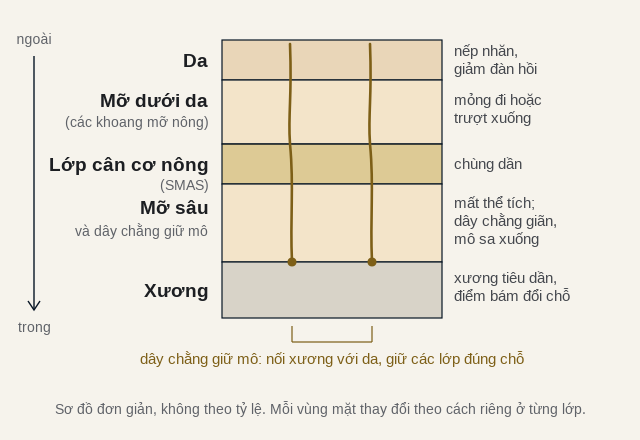
The soft tissue of the face is usually described as stacked layers from superficial to deep: skin, subcutaneous fat, the superficial musculoaponeurotic system (SMAS), then a loose areolar layer with the retaining ligaments, and finally the bony foundation[3]. Retaining ligaments are bands of connective tissue linking bone to skin, holding the layers in position as the facial muscles move[2].
Each layer ages in its own way
According to a 2025 review of retaining ligaments, age weakens and stretches these ligaments, leading to descent of fat compartments, skin laxity, jowling, deeper nasolabial folds and visible platysmal bands in the neck[2]. The grooves of the lower eyelid and cheek are also linked to ligaments at the lid–cheek junction[2].
The bony foundation also changes. A 2012 review compiling CT studies showed that the orbit widens with age, especially superomedially and inferolaterally; the maxillary angle decreases by about 10 degrees between people under 30 and those over 60; in the mandible, the gonial angle opens while the height and length of the mandibular body decrease[1]. The authors suggest that more visible tear troughs, nasolabial folds and jowling are partly a consequence of bony retrusion, which shifts ligament and muscle attachments[1]. This is a descriptive review, but it explains why simply tightening the skin does not address the root of the problem.
Fat and volume change differently in each region: in some areas fat slides down, in others volume is lost and the area becomes hollow.
What does the doctor look at in each region?
The points assessed, from top to bottom:
- Forehead and brows: horizontal lines, the degree of forehead descent and brow position. A drooping lateral brow makes the upper lid look heavy and is easily mistaken for ptosis, so it needs to be distinguished before eyelid surgery is considered.
- Temples: lax soft tissue pulls the tail of the brow and the lateral canthus downward; volume loss makes the temples hollow.
- Periorbital area and midface: lax eyelid skin, fat bags, tear troughs and the lid–cheek junction; descent of the malar soft tissue makes the tear trough and nasolabial fold more visible.
- Cheeks and nasolabial folds: fullness and degree of sagging of the cheeks; depth of the fold, usually related to descent of the tissue above it.
- Jawline: jowling makes the jawline less defined. The mandibular ligament is regarded as the anterior border of this sagging tissue[3].
- Neck: lax skin and platysma, and a blunted cervicomental angle. The platysma is attached to both the skin and the fascia beneath, so addressing this muscle layer is considered important when redefining the neck contour[3].
The doctor also considers skin quality, underlying conditions, current medications, smoking, previous interventions (surgery, thread lifts, fillers) and the degree of change you would like.
Why does this approach determine the treatment direction?
Areas that mainly sag need support at the correct tissue layer; areas that mainly lose volume may need volume replacement, when indicated; many people need a combination. Surgery does not change skin quality or fine wrinkles, does not stop the ageing process, and every technique involves scars, swelling, bruising and recovery time. No single technique suits everyone.
When should a child be seen early?
Call 115 or go to the emergency department immediately if one side of the face suddenly droops or becomes weak, together with difficulty speaking, limb weakness or double vision: this may be a sign of stroke, not an aesthetic issue.
See a doctor promptly if you have a new lump on the face or neck, or if one side of the face changes rapidly over a few weeks.
Where procedures are performed
At the clinic, procedures are performed only under local anaesthesia, within the list of procedures approved by the Department of Health; other operations and cases requiring general anaesthesia are performed at an appropriately licensed hospital. Dr. An will discuss the details during your consultation. Deep plane facelift and endoscopic temporal–midface lift are performed at an appropriately licensed hospital.
References
- Mendelson B, Wong CH. Changes in the facial skeleton with aging: implications and clinical applications in facial rejuvenation. Aesthetic Plast Surg. 2012;36:753-760. doi:10.1007/s00266-012-9904-3
- Tarallo M, Cilluffo M, Papa F, Fanelli B. Retaining ligaments of the face: still important in modern approach in mid-face and neck lift?. J Pers Med. 2025;15(12):582. doi:10.3390/jpm15120582
- Boyd CJ, Ceradini DJ. Current trends in facelift and necklift procedures. J Clin Med. 2025;14(12):4273. doi:10.3390/jcm14124273
The references above are open-access publications by other groups of authors, listed for further reading. This article only summarises what the authors describe, along with the limitations of each study.
Learn more