Deviated nose and dorsal hump: why do these two problems so often occur together?
Deviation and a dorsal hump are two different problems, yet they often occur together in the same person. This article explains how the literature describes them, and why deviation affects surgical planning more.
The two things people mention most often when they come in about their nose are “my nose is crooked” and “there is a bump on my nasal bridge”. In many cases both are present on the same nose. The literature describes them as two separate problems, but they are related in a way that directly affects surgical planning.
The two most common problems
A retrospective study of 293 people seeking rhinoplasty at a hospital in Saudi Arabia found that a dorsal hump was the most common presentation, at 59.0%, followed by external nasal deviation, at 54.6%[1]. In the same study, nasal deviation differed significantly by sex, whereas dorsal hump did not[1]. This was a single-centre, retrospective study in a Saudi population, so its rates should not be extrapolated to Vietnamese patients.
Another retrospective study of 90 Asian patients undergoing primary rhinoplasty, all operated on by one surgeon, reported similar figures: a dorsal hump in 71% and nasal deviation in 70%[2].
Why the two so often occur together
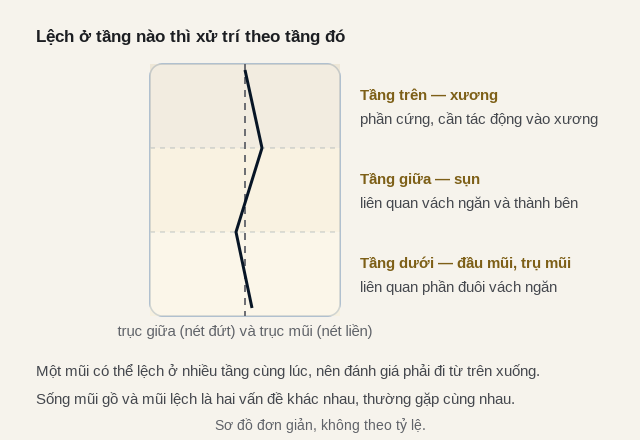
The same study of 90 patients found that 83% of those with a dorsal hump also had nasal deviation[2]. In odds-ratio terms, nasal deviation overall was associated with a dorsal hump at 7.7 times, and bony deviation alone at as much as 14 times, whereas deviation limited to the cartilaginous part showed no statistically significant association[2].
This suggests that the bony vault is where the two problems meet. And it has a practical consequence: in the same study, it was nasal deviation — not the dorsal hump — that predicted the need for intraoperative work on the bone[2]. In other words, someone with only a small hump may not need bony work, whereas someone with clear deviation at the bony level is more likely to need it.
The authors clearly state the limitations: the retrospective design does not allow causal conclusions, the sample was small and from a single centre, all patients were Asian, and morphological assessment remains partly subjective[2].
Treatment follows the level of deviation
A prospective cohort study of 60 Egyptian patients classified nasal deviation into a five-group system, with a fairly even spread from 30% in the first group down to 10% in the fifth[3]. The measured deviation angle improved significantly after surgery, and 3 of the 60 patients required revision, i.e. 5%[3]. Another notable detail: 43 of the 60 patients also had turbinate hypertrophy[3], meaning the airway usually has to be addressed at the same time rather than separately.
The authors also observed that bilateral spreader grafts gave better results in severe deviations than suture techniques, and that caudal septal extension grafts were more suitable for the caudal portion[3]. This is the view of a single-centre study, which the authors themselves list as a limitation[3].
As for the bone, a large series of 864 structural rhinoplasties reported that 25 patients, about 3%, needed one additional bony procedure, and all were corrected at the 6-month mark[4]. The reasons given included bones that were not yet straight or not sufficiently mobilised, and palpable irregularities under the skin[4]. Mean follow-up in this series was 3.7 years[4]; the authors note the limitations of a single-centre study and shorter follow-up in some subgroups.
When should a child be seen early?
If your nose becomes deviated after an injury, see a doctor early, within the first few days, because early management differs from the management of a deviated nose whose bones have already healed.
Come back for review if a deviated nose is accompanied by worsening one-sided obstruction or recurrent nosebleeds, or if, after surgery, the axis becomes more visibly deviated over time.
Where procedures are performed
At the clinic, procedures are performed only under local anaesthesia, within the list of procedures approved by the Department of Health; other operations and cases requiring general anaesthesia are performed at an appropriately licensed hospital. Dr. An will discuss the details during your consultation. Cases requiring rib cartilage harvest are performed at an appropriately licensed hospital.
References
- Alotaibi AD, Alsuwayt BN, Raghib RN, Alsayer RS, Albarrak SM, Alrasheedi AN, et al. Types of nasal deformities in individuals seeking rhinoplasty at governmental hospital in Saudi Arabia. Front Surg. 2024;11:1426170. doi:10.3389/fsurg.2024.1426170
- Kim SJ, Bang JH, Lee KH. Hump nose and coexisting deviation in rhinoplasty: their association and surgical considerations. J Clin Med. 2026;15(1):158. doi:10.3390/jcm15010158
- Elgayar HM, Zeina AM, El-Hadidy MR, El-Sabbagh AH. Nasal deviation management of a group of Egyptian patients. Egypt J Otolaryngol. 2025;41:197. doi:10.1186/s43163-025-00946-9
- Bracaglia R, Servillo M, Fortunato R, Caretto AA, Gentileschi S. Double lateral osteotomy: not only the correction of crooked noses but a relevant aesthetical refinement in structural rhinoplasty. J Pers Med. 2023;13(11):1619. doi:10.3390/jpm13111619
The references above are open-access publications by other groups of authors, listed for further reading. This article only summarises what the authors describe, along with the limitations of each study.
Learn more