
Infection around implants: why must it be managed early?
When the area around a breast implant or other implant shows signs of infection, the timing of your visit directly affects the chance of keeping the implant. This article explains the timelines, signs and management approaches described in the literature.
Implant-related infection is not common, but it is a situation in which time plays a major role. This article explains why your doctor wants to see you early rather than having you wait a few more days at home.
Early and late: two patterns of onset
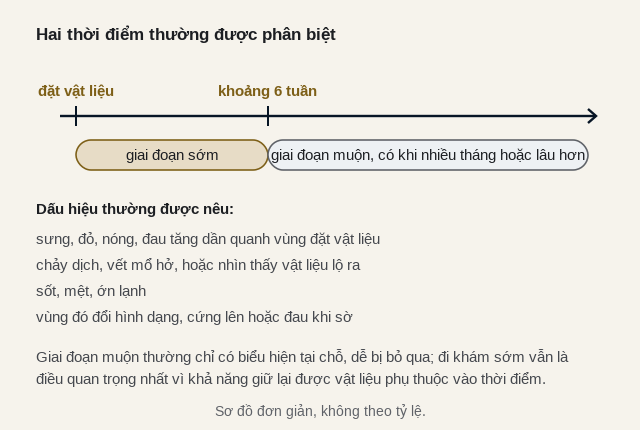
In a multicentre retrospective study of 214 people who required implant removal for periprosthetic breast infection, the authors grouped cases using a six-week cut-off: onset within the first six weeks was early, later onset was late; 62% were early and 38% late[1]. Early cases often had both local and systemic signs, whereas late cases mostly had only local signs and were easily underestimated[1].
Late infection can appear long after surgery. In a series of revision operations for chin implant complications, a recorded infection occurred after a filler injection performed elsewhere, two years after the implant had healed[5]. An existing implant therefore needs to be taken into account whenever a new procedure is performed nearby.
Why early presentation matters
The clearest figures come from a retrospective study of 6,901 people who underwent implant-based breast reconstruction: 184 (2.7%) required unplanned reoperation for a threatened implant, and in that group 90.2% required removal, with only 9.8% salvaged; infection was present in 77.7% of the removal group[2]. The median time from the initial operation to this intervention was 4 months[2].
By contrast, reports using a rapid management protocol show quite different results. One group described a protocol of fluid aspiration to identify the organism, early surgical debridement, then pathogen-directed antibiotic therapy, with a mean time from symptom onset to intervention of only about a day and a half; all 11 patients in that series retained their implants[3]. Another study comparing two periods at the same centre reported that the implant salvage rate rose from 42.1% to a markedly higher level when periprosthetic irrigation was added[4].
These figures should be read with caution: they come from small, single-centre series without control groups, and the authors themselves clearly state those limitations; the literature they cite shows salvage rates varying very widely between reports[3][4]. The takeaway is not a specific rate but a general direction: the earlier the intervention, the better the chances.
Why antibiotics alone are often not enough
Bacteria adhering to the implant surface form a biofilm, making drugs less effective, and cultures may be negative even when infection is present: in the 214-patient study above, nearly a quarter of cultures grew no bacteria[1]. Another study found that the antibiotics given before surgery covered the isolated pathogen in only about half of cases[2]. That is why doctors usually want to obtain a sample before prolonged antibiotic use, and why “taking a few more days of pills to see” can waste valuable time.
When should a child be seen early?
Come in immediately, without waiting for your appointment, if the implant area becomes swollen, red, warm or increasingly painful; there is drainage; the incision opens; the implant becomes visible; or you have fever, chills or marked fatigue[1]. A sudden change in shape or hardening of the area is also a reason to be seen.
Call 115 or go to the emergency department if you have a high fever with drowsiness or confusion, low blood pressure, difficulty breathing, or if the infected area spreads rapidly within a few hours.
If you have an implant and plan to have filler injections, dental treatment or another procedure in a nearby area, inform the treating doctor beforehand.
Where procedures are performed
At the clinic, procedures are performed only under local anaesthesia, within the procedures approved by the Department of Health; removal of facial filler or implant material and revision after eyelid surgery or facelift are performed at the clinic. Revision after breast surgery, abdominoplasty, body liposuction and cases requiring general anaesthesia are performed at an appropriately licensed hospital. If you suspect an infection, contact us early for guidance on where to be examined.
References
- Lisa AVE, Zeneli F, Mazzucco M, Barbieri B, Rietjens M, Lissidini G, et al. Microbiology of periprosthetic infections following implant-based breast reconstruction surgery: a multicentric retrospective study. Front Surg. 2024;11:1477023. doi:10.3389/fsurg.2024.1477023
- Im K, Huang SY, Jiangliu Y, Yoshinaga S, Bai A, Chu MW, et al. Factors affecting implant salvage in patients with complications after post-mastectomy implant-based reconstruction. J Clin Med. 2025;14(8):2682. doi:10.3390/jcm14082682
- Caputo GG, Scarabosio A, Ferrari A, Pagotto A, Mahrhofer M, Weitgasser L, et al. Implant salvage in post-mastectomy reconstruction complicated with infection: molecular diagnosis and negative-pressure wound therapy combined with expander. Plast Aesthet Res. 2025;12:18. doi:10.20517/2347-9264.2024.150
- Gowda MS, Jafferbhoy S, Marla S, Narayanan S, Soumian S. A simple technique using peri-prosthetic irrigation improves implant salvage rates in immediate implant-based breast reconstruction. Medicina (Kaunas). 2023;59(11):2039. doi:10.3390/medicina59112039
- Pokrowiecki R. Revision surgery after complications of silicone chin implants. J Clin Med. 2026;15(4):1326. doi:10.3390/jcm15041326
The references above are open-access publications by other groups of authors, listed for further reading. This article only summarises what the authors describe, along with the limitations of each study.
Learn more