
Endoscopic midface and temporal lift: what can it do, and where are its limits?
Endoscopy allows tissue to be lifted through short incisions within the hairline, but its effect weakens towards the jawline. This article summarises the large published series, what is commonly seen after surgery and what the literature cannot yet answer.
Endoscopic facial rejuvenation lifts tissue through a few short incisions hidden within the hairline, using a small viewing scope instead of a long incision. This is appealing because there are fewer visible scars. But the more important question is which areas this technique reaches, and which lie beyond it.
Which areas endoscopy can reach
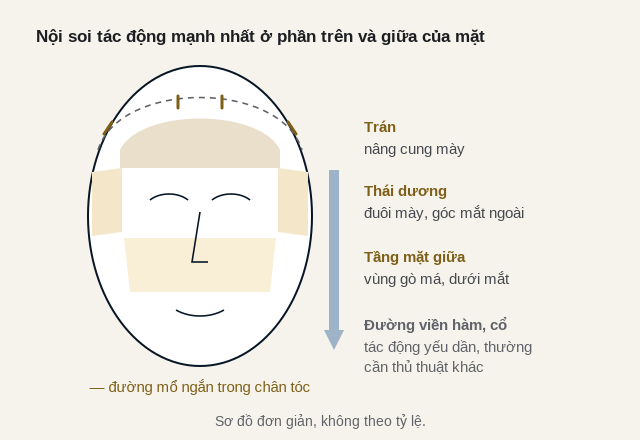
One surgeon summarising 35 years of experience with about 824 cases describes endoscopy as acting mainly on the forehead, temples and midface[1]. Endoscopic forehead lifting can raise the brows and take up a small amount of upper eyelid skin, but when there is substantial excess eyelid skin, blepharoplasty is still required[1].
The limitation is clearly stated by the author himself: the midface lifting effect weakens with distance from the cheekbone down to the jawline, so sagging of the jaw and lower face usually requires an additional procedure[1]. The author also notes that part of the lifting effect is lost after the internal suspension sutures are removed[1]. This is one surgeon’s experience report, without a comparison group, and the author declared conflicts of interest with several device companies.
Another series using endoscopy with short vertical incisions in younger patients — 184 people with a mean age of about 31 — states plainly that people with heavy faces and prominent cheekbones are not suitable candidates for their technique[3].
What is commonly seen after surgery
The largest series in this group, 784 people followed for at least one year, lists fairly comprehensively what happens after surgery[2]. Periorbital bruising occurred in 88.0% and small depressions at fixation points in 81.0% — these are common changes, not serious complications. Temporary hair loss around the incisions occurred in 20.0%, swelling lasting more than 15 days in 19.0%, and temporary forehead–scalp numbness in 7.0%[2].
Temporary weakness of the frontal branch of the facial nerve was recorded in 0.9%, infection or delayed healing in 0.6%, and the revision rate was under 2%[2]. Note that this is a single-surgeon retrospective study using a minimal-incision technique, so these figures cannot be extrapolated to facelifts involving skin flap dissection.
With a combined intraoral and temporal approach, the authors reported that nearly everyone had reduced sensation below the eye, recovering on average in about 72 days, and in one case up to 272 days[3]. They also acknowledge that the technique’s main drawback is a relatively high risk of infection: 5 people developed infection, one of whom was readmitted for drainage[3].
Recovery time
According to the 35-year report, recovery takes about 2–3 weeks with endoscopy alone, and 4–6 weeks when combined with a facelift or neck procedure; subtle swelling hard to see with the naked eye may persist for up to 6 months[1]. Assessing the result at the second or third week is therefore too early.
What the literature has not yet answered
A review on choosing the dissection plane in endoscopic forehead lifting concluded that current evidence is insufficient to establish any plane as superior, and that most evidence comes from anatomical, cadaveric, technical or retrospective studies[4]. The review also emphasises that the course of the temporal nerve branch should be understood as a danger zone that varies between individuals, not a fixed line[4].
None of the series in these sources reported a numerical rate of recurrent sagging over time. A “long-lasting” result therefore cannot yet be tied to a specific number of years.
When should a child be seen early?
Contact your doctor immediately if one side of the face becomes rapidly tense and swollen, pain keeps increasing, your vision blurs or there is aching around the eye, or if you have a fever with cloudy fluid draining from an incision in the hairline or inside the mouth.
Mention it at your follow-up visit if you cannot raise one eyebrow, if forehead–scalp numbness has not improved after a few months, or if hair around the incisions does not grow back.
Where procedures are performed
At the clinic, procedures are performed only under local anaesthesia, within the procedures approved by the Department of Health; forehead lift and temporal lift are performed at the clinic. Endoscopic facelift and midface lift are performed at an appropriately licensed hospital. Dr. An will discuss the specifics at your consultation.
References
- Ramirez OM. Endoscopic assisted facial rejuvenation: a 35 year personal journey. Plast Aesthet Res. 2020;7:25. doi:10.20517/2347-9264.2019.78
- Gennai A, Colli M, Gaggio L. 22 years of Minimal Incision Vertical Endoscopic Lift: a journey in endoscopic facial rejuvenation. Front Surg. 2025;12:1634862. doi:10.3389/fsurg.2025.1634862
- Gencer M, Kerem M, Sağlam Y, et al. Dual-plane midface lift through transoral and transtemporal approach. Aesthetic Plast Surg. 2024;48:4609–4618. doi:10.1007/s00266-024-04222-8
- Zhou B, Liu B, Lan T. Anatomy-guided dissection plane selection in endoscopic brow lift: a narrative review of supraperiosteal, subperiosteal, and multiplane approaches. Front Surg. 2026;13:1856741. doi:10.3389/fsurg.2026.1856741
The references above are open-access publications by other groups of authors, listed for further reading. This article only summarises what the authors describe, along with the limitations of each study.
Learn more