
Scar contracture: why does the direction of a scar matter?
Scars running across skin tension lines are under greater tension, so they are more likely to widen and contract. This article explains the role of scar orientation, how to reduce tension when closing a wound, and when a scar needs to be reoriented.
Two people with incisions of the same length may end up with very different scars. One reason is the direction of the scar relative to the tension of that area of skin. This article explains this and what can be done for a scar that already lies in an unfavourable direction.
Each area of skin has its own direction of tension
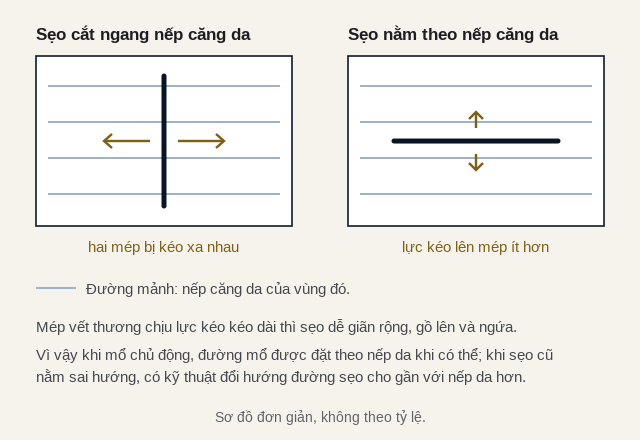
Since 1962, skin tension lines of the face, and later of the trunk, have been described and used to guide incisions; the general principle is to place incisions parallel to these lines whenever possible[1]. A simple bedside way to find the direction is to gently pinch the skin and see which way the fold runs[1].
Tension direction also explains the shape of raised scars: on the anterior chest, tension runs horizontally, so keloids there tend to grow horizontally, and low-tension areas such as the eyelids very rarely develop keloids[4]. Another notable detail: superficial injuries that do not reach the reticular dermis do not produce keloids or hypertrophic scars[4].
The clearest illustration comes from the abdominal wall: a cited study found that scars after midline vertical incisions were on average 8.3 mm wide, compared with 3.3 mm after transverse incisions[1]. These are observational data from a specific patient group, not a randomised comparison, but they are consistent with the principle above.
Tension reduction happens in the deep layers, not in the skin sutures
A common misunderstanding: neat skin suturing is not enough for a good scar. According to a technical reference, suturing the deep fascia reduces about 90% of the tension on the wound edges, with the superficial fascia taking up the rest; dermal sutures handle only the small remainder[2]. The dermis also needs time: about three months after injury it reaches only around 80% of the strength of intact skin, so internal suture material must hold for at least that long[2].
Joints are the most difficult areas, because movement exerts repeated tension on the wound, which can sustain inflammation in the dermis and lead to red, raised, firm and painful scars[2].
When a scar already lies in an unfavourable direction
At this point the goal is not to erase the scar but to reorient it and break up the tension. Z-plasty reorients the scar closer to the skin lines and divides one long scar into shorter segments; these segments usually stabilise faster than one long continuous scar[2]. For contractures across joints or in the neck, this is also the most widely used technique[3].
Scar contracture is described as scar tissue causing a skin deficit during movement, which may range from 2 to 10 cm depending on the case[3]. Timing matters: most cases respond to active rehabilitation if detected early, about one month after the wound has healed, whereas later cases often require surgery[3]. With a properly conducted rehabilitation programme, more than 90% of patients regain normal function after two years; but the authors themselves note that evidence for splinting is limited, and that surgery always restarts the rehabilitation process[3].
Regarding coverage: split-thickness skin grafts heal quickly at the donor site but carry a higher risk of recontracture because they lack dermis, so for scar contractures, local skin flaps are usually preferred[3][4].
When should a child be seen early?
See an ophthalmologist or go to the emergency department immediately if a scar around the eye pulls the eyelid so the eye cannot close fully, with redness, grittiness, pain or blurred vision: the cornea needs early protection.
See a doctor early if a scar restricts joint movement, makes it hard to open the mouth, pulls the corner of the mouth or the nasal ala out of position, or if the scar repeatedly cracks, ulcerates or weeps. In growing children, scar contractures need monitoring because the scarred area does not grow with the body.
Where procedures are performed
At the clinic, procedures are performed only under local anaesthesia, within the procedures approved by the Department of Health; scars of the face and neck, including contractures requiring small skin flaps, are treated at the clinic. Scars on the trunk and limbs and cases requiring large flaps or extensive skin grafting are performed at an appropriately licensed hospital. Dr. An will discuss the specifics at your consultation.
References
- Lemperle G. Prevention of hyper- and hypotrophic scars through surgical incisions in the direction of the main folding lines of the skin. Plast Aesthet Res. 2020;7:40. doi:10.20517/2347-9264.2020.14
- Ogawa R. Ideal wound closure methods for minimizing scarring after surgery. In: Téot L, Mustoe TA, Middelkoop E, Gauglitz GG, editors. Textbook on Scar Management. Cham: Springer; 2020. Chapter 21, pp. 185-191. doi:10.1007/978-3-030-44766-3_21
- Masanovic MG, Téot L. Scar contractures. In: Téot L, Mustoe TA, Middelkoop E, Gauglitz GG, editors. Textbook on Scar Management. Cham: Springer; 2020. Chapter 13, pp. 117-122. doi:10.1007/978-3-030-44766-3_13
- Ogawa R. Keloid and hypertrophic scars are the result of chronic inflammation in the reticular dermis. Int J Mol Sci. 2017;18(3):606. doi:10.3390/ijms18030606
The references above are open-access publications by other groups of authors, listed for further reading. This article only summarises what the authors describe, along with the limitations of each study.
Learn more