
Autologous cartilage in rhinoplasty: where does it come from and how much can be harvested?
Septal, ear (conchal) and rib cartilage differ in shape, stiffness and the amount that can be harvested. This article explains why a surgeon chooses one source over another, and the trade-off that comes with each choice.
When discussing rhinoplasty with autologous cartilage, the question often stops at “is real cartilage used?”. But the questions that matter more for the outcome are: where is the cartilage taken from, how much can be harvested, and what is the trade-off. This article summarises what the open-access literature describes about the three commonly used cartilage sources.
Three sources, three different characteristics
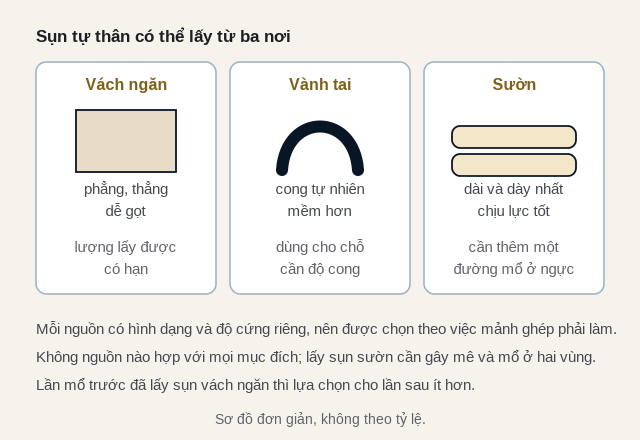
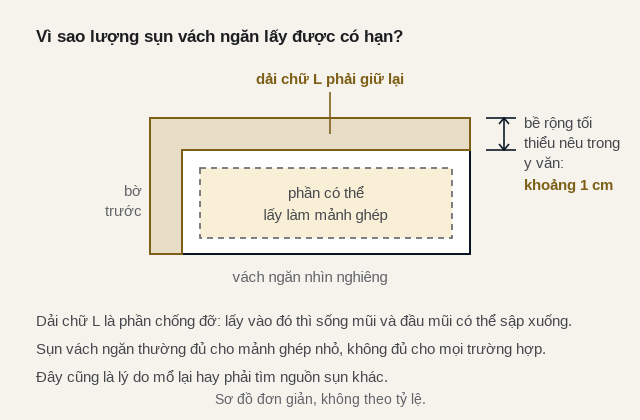
Septal cartilage is flat and straight, so it is easy to carve into small grafts. However, the amount that can be harvested is limited by a technical requirement: the L-shaped framework along the nasal dorsum and the anterior border must be preserved with a minimum width of about 1 cm; otherwise the dorsum and the nasal tip may lose their support[1].
Ear cartilage is naturally curved and softer, suitable for areas that need curvature. Rib cartilage is the longest and thickest, so it bears load better than the others; it is usually harvested from ribs 5 to 11, with the 7th rib used most often[1]. The harvested segment is usually about 4.5–6.5 cm long, and longer in revision cases[2].
Grafts are smaller than you might think
One point that is rarely mentioned is that grafts in rhinoplasty are quite small. In one technical review, a columellar strut graft is typically about 14–16 mm long, 2–3 mm wide and 1–2 mm thick; a caudal septal extension graft is about 18–20 mm long and about 10 mm wide; spreader grafts are about 25 mm long and 3–5 mm wide[1]. So a nose that needs many grafts may exceed the available septal cartilage, even in someone who has never had surgery.
What harvesting rib cartilage costs you
Harvesting rib cartilage requires an additional incision on the chest. In one technical article for Asian patients, the chest incision is given as about 2–3 cm in the methods section, while the discussion gives a wider range depending on chest wall thickness and the surgeon’s experience[2]. The same article recommends a chest CT scan for patients over 40 because the cartilage may already be calcified, yet the authors themselves note that calcification is still seen in younger patients[2].
Rib cartilage also tends to warp after carving. One described approach is to leave the carved cartilage for about 15 minutes so that any warping becomes apparent before placing it in the nose[2]. In a large meta-analysis of dorsal augmentation materials, the highest rate of graft warping was reported in the autologous rib cartilage group, about 7.1% — a figure shared with another combined-graft group — and the lowest in ear cartilage, 1.4%[3]. The same analysis showed that donor-site complications were reported most often in the ear cartilage group, but the confidence interval was so wide that it is hard to interpret for any individual.
The authors of this meta-analysis themselves state that the “success rate” outcome in their study is subject to publication bias, meaning the success figures should be read more cautiously than the complication figures[3].
The part that depends on the patient
A retrospective cohort of 447 Asian patients who had rhinoplasty with autologous rib cartilage at two centres in China recorded adverse events in about 24–27% depending on the group, in patients with a mean age of about 25[4]. When analysing factors associated with complications in the first month, the leading factors all related to post-operative habits: trauma to the nose, folliculitis at the surgical site, contact with animals, spicy food and smoking[4]. The authors themselves state that their prediction model missed most of the cases that went on to have complications, so it is not a predictive tool.
Another source recommends stopping smoking at least two weeks before surgery and for one to two months afterwards[2]. This is the part the patient can control.
When should a child be seen early?
Contact your surgeon if nasal swelling and pain keep increasing after the initial period, redness spreads, there is cloudy discharge, the skin over the dorsum or tip becomes shiny, tight and discoloured, or you develop a fever.
For the chest donor site, report immediately if you have shortness of breath, chest pain that worsens on deep breathing, or a swollen, draining wound. A nose that becomes more visibly crooked over time, or a graft edge that can be felt protruding under the skin, is also a reason to be re-examined.
Where procedures are performed
At the clinic, procedures are performed only under local anaesthesia, within the list of procedures approved by the Department of Health; other operations and cases requiring general anaesthesia are performed at an appropriately licensed hospital. Dr. An will discuss the details during your consultation. Cases requiring rib cartilage harvest are performed at an appropriately licensed hospital.
References
- Zhao A, Brownlee B, Park S. Strategic grafting in rhinoplasty. Plast Aesthet Res. 2025;12:35. doi:10.20517/2347-9264.2025.61
- Rajbhandari S, Kao CH. Costal cartilage graft in Asian rhinoplasty: surgical techniques. Plast Aesthet Res. 2019;6:8. doi:10.20517/2347-9264.2018.86
- Shafik AG, Mohamed MN, Mady OM, Fatallah ES, Tawfik GM, Mahmoud MH, et al. Outcomes and complication rates of different materials used for nasal dorsal augmentation in septorhinoplasty: a systematic review and meta-analysis. Egypt J Otolaryngol. 2025;41:49. doi:10.1186/s43163-024-00746-7
- Niyazi A, Tuohuti T, Nannan X, Shalimujiang D, Zhao Y. Development of a prognostic prediction model and visualization system for autologous costal cartilage rhinoplasty: an automated machine learning approach. Front Surg. 2025;12:1594514. doi:10.3389/fsurg.2025.1594514
The references above are open-access publications by other groups of authors, listed for further reading. This article only summarises what the authors describe, along with the limitations of each study.
Learn more