
Abdominoplasty or liposuction: how is the choice made?
The abdominal wall has three layers — skin, fat and the musculofascial layer; each fails in its own way and needs its own treatment. This article explains the published algorithms for choosing a technique and why measurements matter more than the amount of fat.
Many people come to the consultation with a simple question: “should I have liposuction or abdominoplasty?”. The answer does not lie in the amount of fat, but in which tissue layer the problem belongs to. This article explains how published authors classify patients and choose a technique.
Three layers, three different problems
The abdominal wall consists of the skin on the outside, the subcutaneous fat layer, and then the musculofascial layer with the two rectus abdominis muscles on either side of the midline. When the midline widens, the two muscles move further apart; this is diastasis recti, in which the muscle sheath remains intact, unlike an abdominal wall hernia[4].
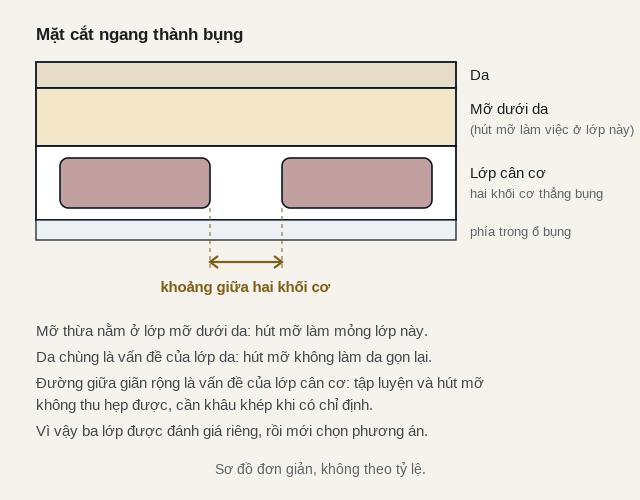
Distinguishing these three layers determines the treatment approach: excess fat lies in the fat layer, lax skin in the skin layer, and a widened midline in the musculofascial layer. A person may have a problem in only one layer, or in all three.
Which measurements do published algorithms rely on?
A retrospective study of 245 patients operated on between 1991 and 2015 describes an algorithm that uses only two parameters: the distance from the umbilicus to the pubis (the authors consider 14–15 cm normal) and skin laxity assessed by a two-handed pinch test[1]. From these two parameters, the authors define five technique groups: excision of skin below the umbilicus when only the skin just below the umbilicus is lax and the umbilicus is left in place; detaching the umbilicus and reinserting it lower when the umbilicus–pubis distance is 15 cm or more but the skin is not lax enough to excise the old umbilical site; and more extensive techniques when there is a large amount of excess skin[1].
Another technical article cites a widely used four-grade classification, pairing each grade with a treatment approach: minimal skin laxity with minimal diastasis can be treated with liposuction alone, whereas marked skin laxity with full diastasis requires a standard abdominoplasty[2]. Notably, in that classification table, the amount of fat is listed as “variable” in all four grades[2]: in other words, the amount of fat is not what determines which technique is chosen.
Why a more extensive procedure calls for more careful consideration
In the 245-patient study above, the overall complication rate was 17.55%, most commonly seroma (10.2%) and hypertrophic scarring (4.48%); this rate rose with the extent of the technique, from 6.66% in the most limited group to about 20–21% in the more extensive groups[1]. That is why the surgeon does not choose a more extensive technique than necessary.
The patient’s condition is also considered first. A report of 93 cases lists commonly used selection criteria: stable health, unchanged weight for at least two months, a body mass index below 30, and stopping smoking at least four weeks before surgery[3]. In that report, drains were removed on average on the eighth post-operative day, and about 12% needed a minor procedure later to address excess skin at the ends of the incision or hypertrophic scarring[3].
The limits of these figures should be made clear: both studies are case series from a single surgical team, without a control group, so they describe experience rather than prove that one technique is better than another. Results vary from person to person.
What these procedures cannot do
Abdominoplasty and liposuction are not weight-loss methods, nor do they replace stabilising your weight first. Liposuction thins the fat layer but does not tighten lax skin, nor does it narrow a widened midline. Every incision leaves a scar; when the umbilicus has to be reinserted, there is an additional scar around it. If you still plan to become pregnant, discuss this beforehand, as the abdominal wall will continue to change.
When should a child be seen early?
Call 115 or go immediately to the emergency department if there is a bulge at the umbilicus or along the midline of the abdomen that is painful, firm and does not go down when lying flat, together with nausea, vomiting or inability to pass stool or gas: this may be a strangulated hernia.
See a doctor early if a new bulge appears in the abdominal wall, if pain at an old surgical scar keeps increasing, or if your abdomen enlarges unusually quickly even though your weight has not increased.
Where procedures are performed
At the clinic, Dr. An examines and advises you. Abdominoplasty and body liposuction are performed at an appropriately licensed hospital. Dr. An will discuss the details with you at your consultation.
References
- Fernandes JW, Damin R, Holzmann MVN, Ribas GGO. Use of an algorithm in choosing abdominoplasty techniques. Rev Col Bras Cir. 2018;45(2):e1394. doi:10.1590/0100-6991e-20181394
- Matarasso A, Suri S, Stein MJ. Lipoabdominoplasty technique. Plast Aesthet Res. 2021;8:57. doi:10.20517/2347-9264.2021.37
- Seretis K. Applying art and science in lipoabdominoplasty: technical and safety considerations. Plast Aesthet Res. 2021;8:51. doi:10.20517/2347-9264.2021.71
- Jessen ML, Öberg S, Rosenberg J. Treatment options for abdominal rectus diastasis. Front Surg. 2019;6:65. doi:10.3389/fsurg.2019.00065
The references above are open-access publications by other groups of authors, listed for further reading. This article only summarises what the authors describe, along with the limitations of each study.