
Facial nerve injury after facial rejuvenation surgery: what is the real risk?
Facial weakness after surgery is mostly temporary, but the published figures vary greatly between studies. This article explains why, the follow-up milestones, and when a specialist assessment is needed.
The facial nerve controls the muscles of expression, and its branches lie close to the area operated on in facial rejuvenation. The question “will my face be paralysed?” is therefore a legitimate one. An honest answer has two parts: most cases are temporary, and the exact figure varies considerably between studies.
Temporary and irreversible are two different things
A review of peripheral nerve injury after aesthetic surgery pooled the rate of facial nerve injury after facelift at about 1.0% for temporary injury and 0.03% for irreversible injury[1]. On the same page, the review cites a retrospective series of 7,068 cases with a rate of 0.7%, of which 0.1% were irreversible, and another study with a temporary injury rate as high as 7.1% after primary surgery[1].
These three figures differ several-fold, and the review itself does not explain the discrepancy. The authors clearly state the limitations: the data are heterogeneous in design, technique and follow-up time; reporting is inconsistent; and most studies only followed patients in the immediate post-operative period[1]. What can be said with confidence is that temporary injury is many times more common than irreversible injury.
Figures from endoscopic case series
For endoscopic techniques, a report of 35 years’ experience recorded temporary frontal branch weakness in about 4% of endoscopic forehead cases, recovering within 1–3 months; zygomatic or buccal branch weakness in under 2%; and temporary weakness of the upper lip elevator muscle in about 4%, recovering on average in about 2 months[2]. The author recorded one case of irreversible unilateral frontal branch injury, in a patient undergoing revision after a previous long-incision operation[2].
A series of 784 patients with a minimal-incision endoscopic technique recorded temporary frontal branch weakness in 0.9%[3]. The study’s complication table has no row for irreversible injury — but “not reported” does not mean “zero”.
Another group describes temporary buccal and zygomatic branch weakness that resolved within about 3 weeks, but did not give the number of cases[4].
Numbness is not paralysis
A common source of confusion: numbness or reduced skin sensation is an injury to a sensory nerve, which is different from muscle weakness caused by injury to a motor nerve. Numbness is more common and has its own pace of recovery. In a series combining intraoral and temporal approaches, almost everyone had reduced sensation below the eye, recovering on average in about 72 days, and up to 272 days in some[4].
A review of endoscopic forehead surgery notes that injury to the deep branch of the supraorbital nerve can cause prolonged numbness of the scalp[5].
Why there is no fixed safe distance
Patients often ask “can the surgeon avoid the nerve?”. The same review states that the course of the temporal nerve branch should be understood as a danger zone that varies from person to person, not an absolutely fixed line, and that safety should not be defined by a single centimetre figure[5]. This is why anatomical experience and controlled dissection matter more than a measuring rule.
Follow-up milestones
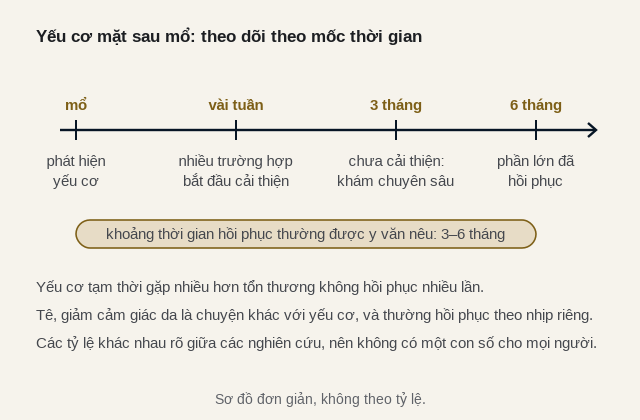
The literature commonly states that facial nerve function recovers after about 3–6 months when injured[1]. The review recommends that if no improvement is seen within about the first three months, the patient should be referred for a specialist peripheral nerve assessment to consider treatment[1]. For temporary injury, management is mainly observation and conservative treatment[1].
When should a child be seen early?
Contact your doctor immediately if after surgery you cannot fully close one eye, your mouth is clearly crooked when you smile, or you cannot raise one eyebrow. An eye that does not close fully needs protection straight away to prevent corneal damage.
Tell your doctor if the weakness shows no improvement at all after a few weeks, if the numbness spreads rather than shrinks, or if there is persistent sharp pain along the surgical area.
Where procedures are performed
At the clinic, procedures are performed only under local anaesthesia, within the procedures approved by the Department of Health; forehead lift, temporal lift and thread lifting are performed at the clinic. Full facelift, endoscopic facelift and midface lift are performed at an appropriately licensed hospital. Dr. An will discuss the details with you at your consultation.
References
- Chen Q, Li P, Zhao Q, Tu T, Lu H, Zhang W. Occurrence and treatment of peripheral nerve injuries after cosmetic surgeries. Front Neurol. 2023;14:1258759. doi:10.3389/fneur.2023.1258759
- Ramirez OM. Endoscopic assisted facial rejuvenation: a 35 year personal journey. Plast Aesthet Res. 2020;7:25. doi:10.20517/2347-9264.2019.78
- Gennai A, Colli M, Gaggio L. 22 years of Minimal Incision Vertical Endoscopic Lift: a journey in endoscopic facial rejuvenation. Front Surg. 2025;12:1634862. doi:10.3389/fsurg.2025.1634862
- Gencer M, Kerem M, Sağlam Y, et al. Dual-plane midface lift through transoral and transtemporal approach. Aesthetic Plast Surg. 2024;48:4609–4618. doi:10.1007/s00266-024-04222-8
- Zhou B, Liu B, Lan T. Anatomy-guided dissection plane selection in endoscopic brow lift: a narrative review of supraperiosteal, subperiosteal, and multiplane approaches. Front Surg. 2026;13:1856741. doi:10.3389/fsurg.2026.1856741
The references above are open-access publications by other groups of authors, listed for further reading. This article only summarises what the authors describe, along with the limitations of each study.
Learn more