Deviated septum: when does it need correcting?
A septum that looks deviated on imaging does not necessarily mean nasal obstruction, and is not in itself an indication for surgery. This article explains the methods of assessment, what surgery can improve and what it may not.
Many people are told they have a “deviated septum” after an examination or a scan. The real question is not whether the septum is deviated, but whether that deviation is causing a problem for that particular person. These two things do not overlap as much as people think.
Imaging and symptoms do not always go together
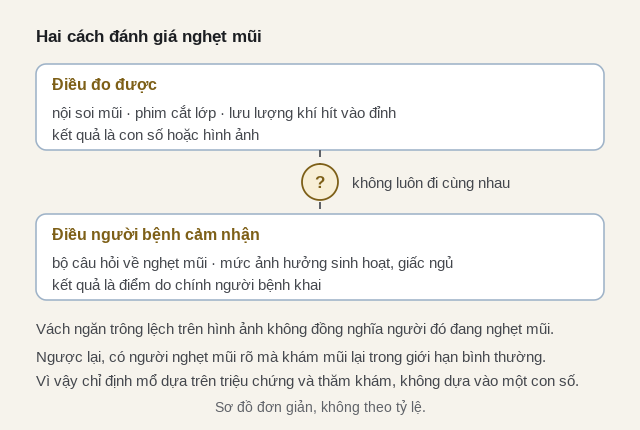
A systematic review of diagnostic tools for septal deviation concluded that there is no gold standard for this diagnosis[1]. In the data pooled there, 30 of 77 people with significant septal deviation reported nasal obstruction; but 32 of 89 people with a normal nasal endoscopy also reported nasal obstruction[1]. In other words, a septum that looks deviated does not mean the person is obstructed, and a septum that looks normal does not rule out obstruction.
Objective measurements do not resolve this either. The same review notes that peak nasal inspiratory flow had a sensitivity of about 79% and a specificity of 77% for detecting septal deviation, while rhinomanometry had a detection rate of 22% against a false-positive rate of 24%, meaning it barely discriminated at all[1]. The authors themselves state that subjective symptom scores correlate poorly with objective measurements[1].
What surgery can improve
A systematic review including only randomised trials, pooling 3 studies with 721 participants, compared septal surgery with non-surgical treatment[2]. Patient-reported nasal obstruction scores improved clearly in the surgery group at all three time points of 3, 6 and 12 months, as did the sinonasal quality-of-life scale[2].
But the same analysis showed that peak nasal inspiratory flow did not improve consistently: the difference was not statistically significant at 3 and 12 months, and significant only at 6 months[2]. This is the most notable point of the evidence: what patients feel improves more clearly than what the device measures.
The authors rated the certainty of the evidence as low to moderate and noted many limitations: only three trials, a highly heterogeneous “non-surgical” group, mostly open-label trials so that subjective outcomes may be biased, and no data on durability beyond one to two years[2].
A prospective study of 32 people who had septoplasty with inferior turbinate reduction showed something similar from the opposite direction: peak nasal inspiratory flow increased clearly after 3 months, but that increase did not correlate with the reduction in daytime sleepiness[3]. The same study recorded a decrease in daytime sleepiness scores and a fall in the proportion at high risk on a sleep-disordered breathing screening questionnaire from 50% to 25%, in a small sample without a control group[3].
Scores do not replace an examination
The nasal obstruction questionnaire is commonly used to quantify symptoms. In a study validating a translated version of this questionnaire, the mean score was 58.3 in patients compared with 14.6 in healthy people, meaning the scale could distinguish the two groups[4]. The median score fell from 60 before surgery to 20 at 1 month and 15 at 3 months, then slipped back slightly to 20 at 12 months[4].
More important is what the authors themselves state: the scale was validated for groups of patients and is not meant to predict outcomes for individuals[4]. A number cannot replace examining the nose, taking a history and finding out when the person is blocked, on one side or both, and whether there is associated allergic rhinitis.
When should a child be seen early?
See a doctor when long-lasting nasal obstruction affects your sleep, daily activities or exercise, when only one side is blocked and it is getting worse, or when it comes with recurrent nosebleeds, purulent nasal discharge, facial pain or reduced sense of smell.
Young children who breathe through their mouth during sleep, snore loudly or have pauses in breathing during sleep should also be examined, because the cause often lies beyond the septum.
Where procedures are performed
At the clinic, procedures are performed only under local anaesthesia, within the procedures approved by the Department of Health; septoplasty that does not require rib cartilage harvest is performed at the clinic. Cases requiring rib cartilage harvest or general anaesthesia are performed at an appropriately licensed hospital. Dr. An will discuss the details with you at your consultation.
References
- Aziz T, Biron VL, Ansari K, et al. Measurement tools for the diagnosis of nasal septal deviation: a systematic review. J Otolaryngol Head Neck Surg. 2014;43:11. doi:10.1186/1916-0216-43-11
- Abd Elhadi U, Safia A, Masalha M. Septoplasty versus non-surgical treatment for deviated nasal septum: a systematic review and meta-analysis. J Clin Med. 2026;15(10):3930. doi:10.3390/jcm15103930
- Sousa FA, Correia JT, Rios M, Ferreira MG, Magalhães M, Santos M. Beyond the airway: the impact of septoplasty and turbinate reduction on somnolence and sleep disordered breathing risk—a prospective study. Front Surg. 2026;13:1828614. doi:10.3389/fsurg.2026.1828614
- Spiekermann C, Savvas E, Rudack C, et al. Adaption and validation of the nasal obstruction symptom evaluation scale in German language (D-NOSE). Health Qual Life Outcomes. 2018;16:172. doi:10.1186/s12955-018-1004-x
The references above are open-access publications by other groups of authors, listed for further reading. This article only summarises what the authors describe, along with the limitations of each study.
Learn more